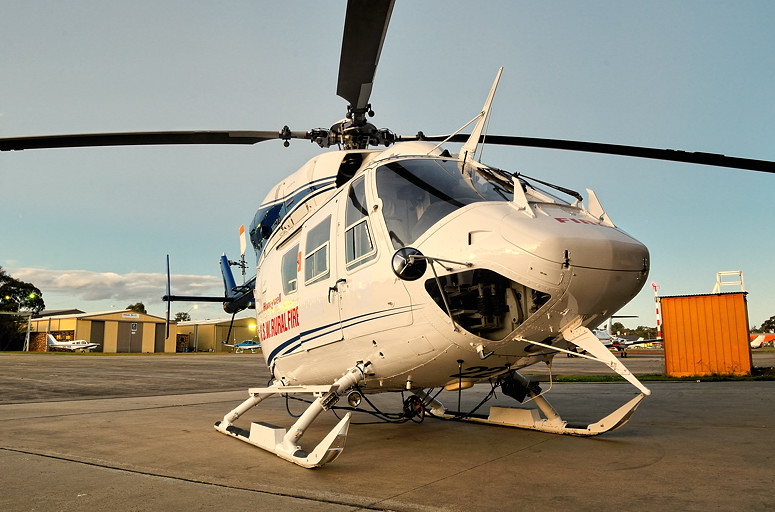
Kawasaki BK117-B2 VH-FHB vs Amanda (Glamour)

Why? why not? gotta love taking pictures of heliochoppers so why not challenge it a bit more with a human element. Now, admittingly this is nothing more than plonking a attractive model in the front of a attractive helicopter but nontheless it can work.

The BK 117 was a joint development between MBB and Kawasaki based on an agreement made on 25 February 1977. The agreement would replace two separate projects for twin-engined general purpose helicopters; the Bo 107 by MBB and the KH-7 from Kawasaki. Costs were shared equally, with MBB developing the rotors (based on the rigid rotor system used on MBB’s Bo 105), tailboom, flight controls and hydraulic system and Kawasaki developing the landing gear, airframe, main transmission and other minor components. Each company would have its own assembly line producing aircraft for local markets.

Each company was to build two prototypes (although Kawasaki only built one) to be completed by 1979; one for flight testing and the others for tie down testing and static testing. MBB’s flying prototype made its first flight at Ottobrunn on 13 June 1979, followed by the Kawasaki prototype at Gifu on 10 August 1979. Development was slower than expected, a problem made worse by shortages of skilled manpower available at MBB. Although it was originally planned for airworthiness certification to be achieved before the end of 1980, German certification was not achieved until 9 December 1982, with Japanese certifiation following on 17 December, and the all-important United States FAA certification being obtained on 29 March 1983.

Amanda the model (MUA Beccy Sedgman)

Cessna Birddog

The U.S. Army was searching for an aircraft that could adjust artillery fire, as well as perform liaison duties, and preferably be constructed of all metal, as the canvas covered Liaison aircraft used during World War II (primarily Stinson and Piper products) had a short service life. The US Army issued the specification for a two-seat liaison and observation monoplane and the Cessna Aircraft Company submitted the Cessna Model 305A, a development of the Cessna 170. The Cessna 305A was a single-engined, light-weight, strut-braced high-wing monoplane with a tailwheel landing gear. The greatest difference from the Cessna 170 was that the 305A only had two seats, in tandem configuration (the largest tandem-seat aircraft that Cessna ever produced), with angled side windows to improve ground observation. Other differences included a re-designed rear fuselage, providing a view directly to the rear (a feature later dubbed “Omni-View” and carried to Cessna single-engine aircraft after 1964), and transparent panels in the wings’ center-section (similar to those found on the Cessna 140 and the later Cessna 150 Aerobat model), which allowed the pilot to look directly overhead. A wider door was fitted to allow a stretcher to be loaded.

Bell 212

The Bell 212 Twin Huey (also known as the Twin Two-Twelve) is a two-bladed, twin-engined, medium helicopter that first flew in 1968. Originally manufactured by Bell Helicopter in Fort Worth, Texas, production was moved to Mirabel, Quebec, Canada in 1988, along with all Bell commercial helicopter production after that plant opened in 1986.[1][2]

The 212 is marketed to civilian operators and has a fifteen-seat configuration, with one pilot and fourteen passengers. In cargo configuration the 212 has an internal capacity of 220 ft³ (6.23 m³). An external load of up to 5,000 lb (2,268 kg) can be carried.

Sikorsky S-64 “Skycrane”

The Sikorksy S-64 was designed as an enlarged version of the prototype flying crane helicopter, the Sikorsky S-60. The S-64 had a six-blade main rotor and was powered by two 4,050 shaft horsepower (3,020 kW) Pratt & Whitney JFTD12A turboshaft engines. The prototype S-64 first flew on May 9, 1962 and was followed by two further examples for evaluation by the German armed forces. The Germans did not place an order, but the United States Army placed an initial order for six S-64A helicopters (with the designation YCH-54A Tarhe). Seven S-64E variants were built by Sikorsky for the civil market.

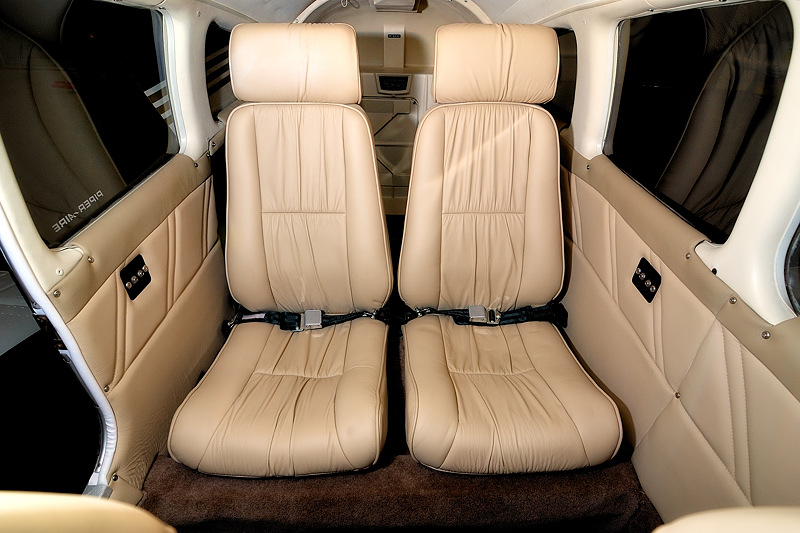
Piper Arrow

The Piper Arrow is the only complex trainer available for purchase direct from an OEM.  The Arrow offers an ideal classroom in the sky for complex, single engine training at a price that is manageable for the smallest of flight schools.  Thousands are in service around the world, so your choice of the Piper Arrow for your training needs is a wise one.

pffft, thats debatable cleary he ain’t seen half of the sh$tboxes sitting on the airport.

Nonetheless, this one is quite tidy, with an nice paint job it would be quick smart…

Staggerwing Vs Chipmunk

Beechcraft Staggerwing

The Model 17’s unusual negative stagger wing configuration (the upper wing staggered behind the lower) and unique shape maximized pilot visibility while minimizing the tendency to stall. The fabric-covered fuselage  was faired with wood formers and stringers  over a welded, steel tube frame. Construction was complex and took many man-hours to complete. The Staggerwing’s retractable conventional landing gear, uncommon at that time, combined with streamlining, light weight, and powerful radial engines helped it perform significantly better than other biplane designs.

In the mid-1930s, Beech began a major redesign of the aircraft, to create the Model D17 Staggerwing. The D17 featured a lengthened fuselage that improved the aircraft’s landing characteristics by increasing the leverage generated by the elevator. They relocated the Ailerons to the upper wings, eliminating any interference with the air flow over the flaps. Braking was improved with a foot-operated brake synchronized to the rudder pedals. These modifications enhanced the Staggerwing’s performance, which was soon put to the test under wartime conditions.
Dehavilland Chipmunk

The Chipmunk was designed to succeed the de Havilland Tiger Moth biplane trainer that was widely used during the Second World War. Wsiewolod Jakimiuk, a Polish prewar engineer, created the first indigenous design of the aircraft at de Havilland Aircraft of Canada Ltd. It is an all-metal, low wing, tandem two-place, single engine aircraft with a conventional tail wheel landing gear and fabric-covered control surfaces. The wing is also fabric-covered aft of the spar. A clear perspex canopy covers the pilot/student (front) and instructor/passenger (rear) positions. CF-DIO-X, the Chipmunk prototype, flew for the first time at Downsview, Toronto on 22 May 1946 with Pat Fillingham, test pilot from the parent de Havilland company, at the controls[1]. The production version of the airplane was powered by a 145 hp (108 kW) in-line de Havilland Gipsy Major 8 engine while the prototype was powered by a 145 hp (108 kW) de Havilland Gipsy Major 1C.

The Model 17’s unusual negative stagger wing configuration (the upper wing staggered behind the lower) and unique shape maximized pilot visibility while minimizing the tendency to stall. The fabric-covered fuselage was faired with wood formers and stringers over a welded, steel tube frame. Construction was complex and took many man-hours to complete. The Staggerwing’s retractable conventional landing gear, uncommon at that time, combined with streamlining, light weight, and powerful radial engines helped it perform significantly better than other biplane designs.

In the mid-1930s, Beech began a major redesign of the aircraft, to create the Model D17 Staggerwing. The D17 featured a lengthened fuselage that improved the aircraft’s landing characteristics by increasing the leverage generated by the elevator. They relocated the Ailerons to the upper wings, eliminating any interference with the air flow over the flaps. Braking was improved with a foot-operated brake synchronized to the rudder pedals. These modifications enhanced the Staggerwing’s performance, which was soon put to the test under wartime conditions.