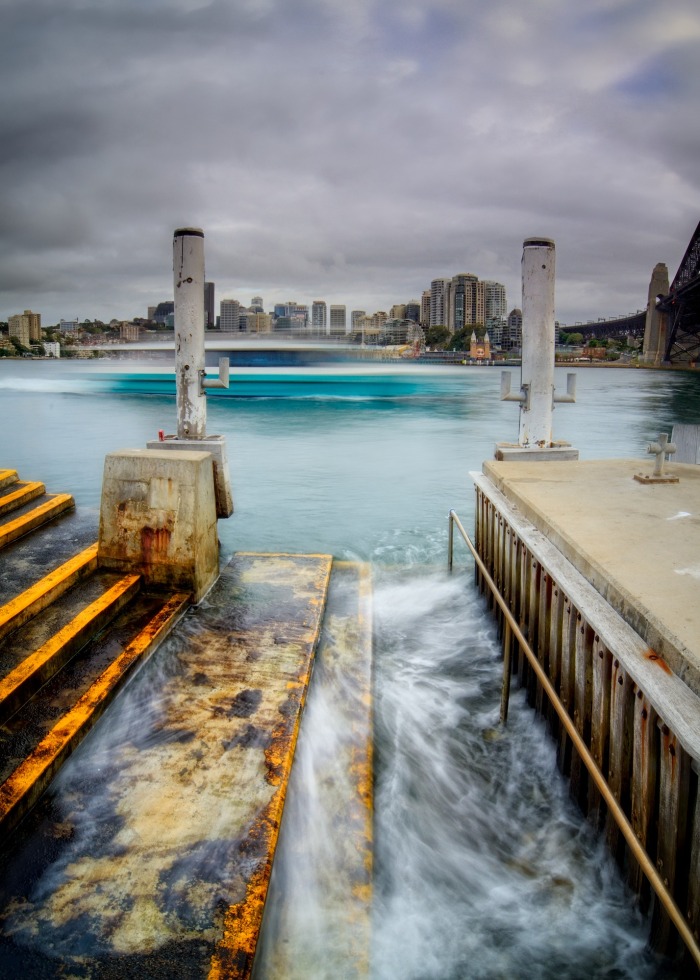
Went for a sunrise session in the city, however, I really struggle to get excited about the Harbour Bridge and Opera House any more – must be Sydney icon-fatigue 🙂 I did even get a pretty cool pano of the opera house with some pretty cool cloud and colour, but this image taken later on appealed more to me, thus got more attention.
I quite liked the motion of the water complimented by the movement of the passing "Fantasia" boat coupled with the brillant yellow antislip steps which just popped out against the mossy and algae eaten concrete.
I also like the quirky composition, not quite following any rules but also not quite breaking any 🙂
Luna Park off in the distance set against the backdrop of Milsons Point and North Sydney, you can see a small fraction of the famous Sydney Harbour Bridge.
Single Frame exposure
Aperture: f/19
Shutter Speed: 1s
Exposure Mode: Manual
ISO Sensitivity: ISO 100
I also think i have portrait orientation addiction…can't seem to get the camera back into landscape orientation.
Nice shot +Gerard Blacklock
+Gerard Blacklock – Unconventional but extremely pleasing to the eye. Thanks!
There's a word ("belvedere") I don't see much.
Great photo +Gerard Blacklock. Very clever mate. =)
Picture…YES…Light…Colors…
bella imagen!
great shot this is +Gerard Blacklock
Great composition and perspective.
Stunning work +Gerard Blacklock
I'm with you on the portrait orientation thing +Gerard Blacklock – I've noticed in my own work over the past few months that I've been doing a lot more verticals than horizontals (and even when I'm doing wide shots I'm doing them as a stitch of a number of tele verticals…)
thankyou all for taking the time to look and comment, much appreciated
+Aravindhan Padmanabhan following on from the graduated filter discussion, here is a example of a complex horizon in this case i placed the grad line on the water line (luna park) then simply recover the shadows on the cityscape and then selectively brightened the posts since the grad filter was quite obvious there. Note the white posts meant it was very easy to recover all of the shadows there with no introduction of noise etc..
Thanks soo much for the continued education +Gerard Blacklock!!.Now that you mention it, I can certainly see the effect the grad filter had! The white posts make for a perfect framing device and without the grad you would have lost all the finer detail on the far shore.
But, with so much energy and luminosity in the foreground, I feel that the background and sky look a bit pale in comparison… The punch in the steps and waves stand out a lot against the rather flat sky.
Is this a side effect of using a ND filter and then attempting to recover shadow detail in post? Sorry if I'm not interpreting the photograph correctly.
hey +Aravindhan Padmanabhan , you right, the sky is a bit pale and dull which reflects the conditions on the day not the effect of the GND (Graduated neutral density) if anythign the GND helps retain some pop/texture to the shadows in the sky when its cloudy like this.
That makes a lot of sense +Gerard Blacklock! I absolutely love the composition and framing… regardless of where you look, your eyes are drawn to the 'fantasia' in the middle! I think I was trying to work out how the sky adds to this photograph.
But I see your point about the GND retaining the shadows in the sky. Many a time with skies like that, I've come home and played around with highlight / shadow balance in LR4.1 but didn't get anything close to this level of clarity! Beautiful work and very refreshing from simply seeing the Opera house again and again (Icon fatigue like you put it 🙂
NB +Aravindhan Padmanabhan – it makes sense that when you use a 2 stop grad or stronger that you're going to have much more latitude in processing (the normally washed out/overexposed/blown out sky) compared to just using the gradient tool say in LR.
The amount of data in RAW files is pretty amazing these days but realistically there's only 1 to 2 stops of room to manoeuvre with say exposure/highlight recovery/shadows/etc before things start to break down badly and you're not bringing back detail (signal) but rather you're just enhancing noise.
Grads aren't perfect of course – the uneven horizon problem as we have here is always a challenge but I think in the end I much prefer using them in the field and having a better base to start with than not.
Thoroughly agree with you +Rodney Campbell. Without the use of ND filters in the field , the other way to go about it would be by bracketing for the sky and land separately, I guess. But I found that it is so easy to over do the recovery process. I'm beginning to see more and more that ND filters in the field make for realistic portrayal of the data that is prone to get blown. Thanks a lot for the guidance.